Cognitive Behavior Therapy is recommended to clients to get the necessary treatment for their negative thoughts to bring about the desired positive change .
The key principle behind CBT is that our thought patterns affect our emotional understanding of the events which, in turn, can affect behavior and subsequent interaction with the people we interact with .
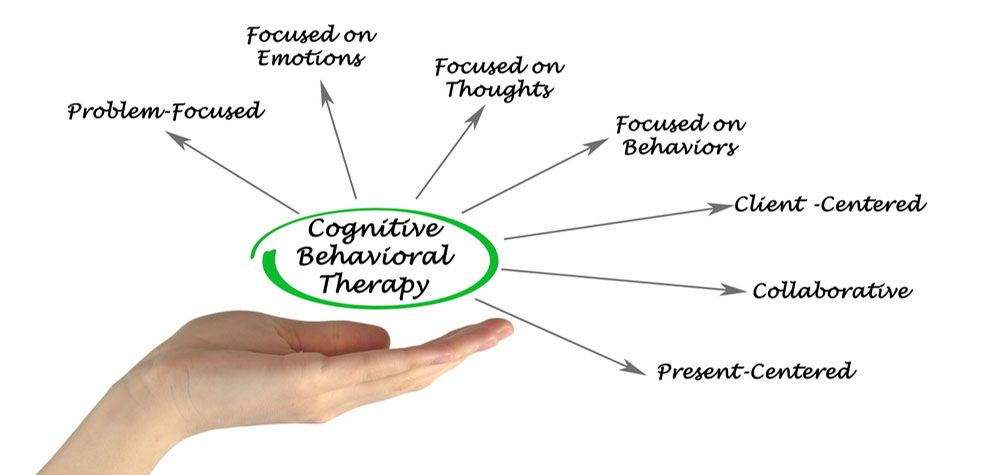
CBT also is believed to make us aware of our own negative emotions influencing our thought patterns .CBT helps us analyse and understand others behaviour as elicited by our own emotional understanding of the situation.
CBT highlights how negative thoughts can bring about negative feelings and actions.Similarly how negative emotions can interpret a positive event ,in negative tones . But, if we reframe our thoughts in a more positive way, it can lead to more positive feelings and helpful behaviors.Or if we work on developing positive emotions about ourselves and situations the thoughts will become more accepting .

While conducting CBT the therapist trains the patient to recognise such negative reading by his mind and how to reinterpret the situation with a positive frame of mind. The patient can continue to use these skills so learnt, in all difficult situations and overcome depression,anxiety or other mood disorders .
Depending on the issue the patient is dealing with and the expected specific goals of the CBT , the therapist can make use of several ways to administer CBT. It will basically involve :
- identifying specific problems or issues in the client’s day to day life.
- Helping the client become aware of unproductive thought patterns and how they can impact his or her life
- identifying negative thinking and reshaping it in a way that changes how he or she feels
- learning new behaviors and putting them into practice
After speaking with the client and learning more about the issue the client wants help with, the therapist will decide on the best CBT strategies to use.
CBT involves making use of the appropriate combination of a few the following 9 strategies:
1. Cognitive restructuring or reframing
This involves taking a hard look at negative thought patterns. When we tend to over-generalize, and apprehend that the worst is about to happen , or tend to get into too much details for every thing we do we find it difficult to act. Our thoughts can prevent us from doing what we want to do and create havoc in our life.
The therapist in this situation will help us identify the negative patterns of our thoughts and inaction . He trains us as to how to reframe those thoughts so they’re more positive and productive and propel our action taking connative behaviour.
For example: “I am not valued in my office because I’m totally useless” can become “I may not be the best worker , but I’m as valuable an employee as can be and I contribute the same way as others do .”

2. Guided discovery
In guided discovery, the therapist will acquaint himself with our viewpoint. Then he will ask questions designed to challenge our beliefs and broaden our thinking.
The client might be asked to give evidence that supports clients assumptions, as well as evidence that does not.
In the process, the client will learn to see things from other perspectives, especially ones that he or she may not have considered before. This can help client choose a more helpful path.
3. Exposure therapy
Exposure therapy can be used to confront fears and phobias . The therapist will slowly expose you to the things that provoke fear or anxiety, while providing guidance on how to cope with them in the moment.This can be done in small increments. Eventually, exposure can make us feel less vulnerable and more confident in our coping abilities whenever the anxieties build up.

4. Journaling and thought records
Putting down your thoughts in writing is a very simple yet effective way of getting in touch with your emotions.One can list down repeated negative thoughts that occur frequently and disturb your homeostasis .It will certainly help to write down your positive thoughts also as would be the inclusion of new thoughts and new behavior for day to day interaction.

5. Activity scheduling and behavior activation
When you are in a negative frame of mind you tend to put off activities in fear or in anxiety.Writing schedules of such activities and visualising them before you begin practicing them can give you the confidence .With such a positive confidence it becomes easy to overcome negative emotions connected with such activities.
6. Behavioral experiments
Behavioral experiments are used for anxiety disorders that involve catastrophic imagining . The psychologist here asks you to express your apprehension as to what will happen if you perform the given task that you otherwise have been dreading to perform. Once you have (reluctantly ) completed the given task you are asked to talk about whether the apprehension came true. Over time, you may start believing that your apprehensive anxiety is not very valid as nothing that you expected to happen actually took place.
7. Meditation, Relaxation and stress reduction techniques.
Perceptive meditation, progressive muscle relaxation and positive imagery building exercises are undertaken to bring about a total positive control over mind ,body and soul to eliminate the phobias,fears anxieties and depression.


8. Role playing
Role playing can help us overcome negative thinking , apprehension and work through difficult relationship and situations. A role play out done with the help of therapist can lessen fear and can be used for:
- improving problem solving skills
- gaining familiarity and confidence in certain situations
- practicing social skills
- assertiveness training
- improving communication skills
9. Successive approximation through small successes
This involves taking tasks that seem overwhelming and breaking them into smaller, more achievable steps. Each successive step builds upon the previous steps so you gain confidence as you go, bit by bit.
To know more about CBT and undertake the same ,please get in touch with us mansikpramarsh@gmail.com
917314263087




















 Sachin (name changed)a young boy of 12 and a student of grade 7th had been termed a big nuisance by his class teachers.They could hardly control his activities.He would just not sit at one place in the classroom. His indiscipline created problems for his teachers in school . Of late he had started arguing back with his tutors at home .There have been complaints of his misbehaving with other children of his class . His mother, a single parent was at her wits end,not knowing how to proceed about. She was advised by the school to consult a psychologist.
 Akshat {name changed} another child was standing outside the school Principal’s office.This was the third time in the current session when his parents have been called to the school by the authorities.Akshat had been sliding down the side railing of the second floor stairs all alone, when he had been intercepted by his class incharge.A joint evaluation by the school teachers,psychologist and psychiatrist diagnosed severe ADHD in the child. Our experience with treating ADHD children in many such cases have proved that mindful perceptive meditation can train and condition the young brain to concentrate better and hold focus even in the event of child suffering from ADHD.Such a holistic intervention and alternative treatment have benefited many and can help your child maintain self regulation, self discipline, and developing a better attention span.
 We have observed that many adults and children affected by ADHD find it very challenging to sustain their attention, and they exhibit a very hyper state of mind in situations where they are expected to remain calm and attentive.
 Mindful perceptive meditation exercise develops the inner peace of mind,establishes positive relationship with the self and brings about sense of confidence and stability of mind.It helps regulate functioning of the endocrine glands of body and creates good hormones in the body. Since mindful perceptive meditation involves perception of breathing, perception of centres of our psychic hence brings about a sea change in the mindset of the protagonists.It enhances attention span. It trains the mind in the process of self-observation , trains to take care of all kinds of negativity and develop an internal power of positivity, attention, and to develop different faculties of mind and intellect . It makes the subject better aware of his or her emotional state of mind and impulsivity.
 HOW DOES YOUR CENTER TEACH THE PRACTICE OF MINDFUL PERCEPTIVE MEDITATION ?
 HOW AND WHERE CAN MY CHILD JOIN MINDFUL PERCEPTIVE MEDITATION PROGRAM?
 Alka Mansik Pramarsh Foundation Clinical Psychologists-Family therapists Indore 0731-4263087,9179383554