
A child -busy studying
- Being easily distracted
- Making “careless” mistakes
- Struggling to follow instructions carefully and completely
- Repeatedly losing things like toys, pencils, or anything you might need to complete a task
Psychiatrists have identified that problem with attention, is often coupled with signs of hyperactivity such as:
- Restlessness and fidgeting
- Dashing about in situations when the child as expected to sit still and be quiet
- Blurting out answers or interrupting others
- Getting really frustrated if you have to wait in line or queue
The symptomatic types of signs associated with attention deficit lead to frequent wrong diagnosis of ADHD. Parents, teachers and doctors have to be keenly alert to whether signs are demonstrated across a number of situations, e.g.in school, at home, during extracurricular activities or if they are isolated to a specific subject area, which may indicate a much more specific problem.
In order to gain a formal diagnosis, psychiatrists/doctors will be looking for evidence that the problems were demonstrated early in life (before the age of 7).
Once a psychiatrist /doctor has this evidence, a full assessment, which often includes lots of different specialists, can start. However, arriving at a formal diagnosis for ADHD can sometimes be a longwinded and frustrating process. Also, because poor concentration often affects progress at school, problems can be compounded with the passing of time.
Once diagnosed, treating a child with ADHD can present a difficult choice: whether or not to make use of medication. Other approaches include behavioral modification and management program.
Symptomatic highlights:
Attention
- Does your child struggle with attention and concentration?
- Balance and Coordination Reading and Writing
It could be dyspraxia or Developmental Coordination Disorder (DCD), a condition that affects around 1 in 30 of us. Boys are at least four times more likely to be affected than girls.
There seems to be some difficulty with the way the brain processes information – it affects planning of what you want to do and how you want to do it.
Often difficulties with coordination go hand-in hand with other issues, such as difficulty with reading, Attention and Organization Skills.
For children with coordination difficulties, actions like running, jumping, balancing and cycling can prove extremely challenging. For adults, this may have translated into difficulty with driving, household chores, cooking and even getting dressed.
The tell-tale signs can be spotted at two levels.
There may be problems with gross motor coordination skills, which may result in:
- Poor balance
- Difficulty learning to catch and throw
- Difficulty learning to ride a bicycle
- Difficulty climbing stairs
- Difficulty learning to get dressed
There may also be problems with fine motor coordination skills, including difficulty with:
- Delicate tasks like using cutlery
- Doing up buttons and zips
- Tying shoe laces or ties
- Handwriting
Often, as time goes on and children get more practice, things may become easier. In some cases, physiotherapy or occupational therapy may be appropriate.
Of all the skills we learn as children, reading and writing are among the most difficult and important. They help us build our knowledge and gain an understanding of the world.

As we get older, our ability to take in and produce written information is considered to be a fundamental skill required for success. So it is not surprising that if reading and writing prove to be difficult skills to learn, it can be a problem for the child, for their parents and for teachers at school.
For children with learning difficulties, learning to read can be an exhausting and frustrating task that simply doesn’t get any easier. In many instances, these difficulties continue into adulthood and the difficulty is hidden or avoided rather than overcome.
Lots of people take the act of reading for granted. For them it is acquired effortlessly and soon becomes second nature. But the processes involved are anything but simple! When we look at some text, a lot of physical, neurological and mental processes have to work together in order for us to make sense of what is on the page.
Our eyes have to track the text in a precise movement; nerves in our eyes take information to the brain; the brain does some special processing to convert that into language; and then that information has to be converted again into meanings.
With a process this complex, there are plenty of things that can (and do) go wrong for some people. It is not that those people are lazy or stupid. In fact they might be trying MUCH harder than other people, but it is simply that their ability to process the information, and make things become automatic, is not as efficient. Learning through practice is consequently much slower than it should be. When children are learning to read, there are a number of different signs that they might be Struggling . Signs include:
- Difficulty sounding out words and recognizing them out of context
- Confusion between letters and the sounds they represent
- Difficulty reading aloud
- Reading without expression
- Ignoring punctuation
- Comprehension difficulties
- Trouble remembering or summarizing what is read
Often people who have significant problems with reading and writing will be diagnosed with dyslexia. This is no reflection on intelligence or IQ (many are bright and creative people).
People tackle difficulties with reading and writing in a number of different ways. For many, the first option is more teaching around word sounds (phonological); for others it is sound-based or visual therapy. All these routes have their merits and their success stories.
- Do you or your child have trouble with movement and coordination?
- Do you or your child have trouble with reading and writing?
Many people, who have taken up the Special Mansik Pramarsh Programme, tell us that their ability to focus on the task in hand improves dramatically.
People who have struggled to run without tripping up, or have never been able to ride a bike, tell us that they are able to do these activities for the first time. For others, it is more about small improvements day after day, but the overall result is similar.
We have successfully worked with thousands of people who have symptoms associated with dyslexia, dyspraxia and ADHD. Those who have completed the Programme have reported outcomes which include:
- Improved Concentration,
- Better Coordination, Increased Self-Confidence,
- More Motivation for Reading and Schoolwork,
- Improvements in Reading and Spelling Scores,
- Enhanced Social Skills And Greater Sporting Ability
Mansik Pramarsh program deals with what some researchers believe may be the underlying cause of learning difficulties; poor cerebellar efficiency. Our program aims to stimulate the cerebellum to improve concentration, coordination, reading, writing and the processing of information, as well as make skills become more automatic.




















 Ashu (name changed) could not do anything in life ever since he had been diagnosed of schizophrenia by the psychiatrist. He had been prescribed psychotic medicines by different psychiatrist doctors wherever his family had taken him to them .Yet nothing helped. His fears and phobias had worsened with time. The voices in his head continued disturbing him. His logical cognitive ability had been completely distorted and for him all the delusions had become the real images and characters.
 Similarly Sheena (name changed) continued with the fear and phobia of persecution at the hands of a person who had long moved out of her life five years ago. Sheena had been diagnosed of delusional disorder (a psychotic disorder).Her life had become completely miserable as she would often get lost into her phobia and would not be able to conduct her normal day to day routine life.
 Soon a very significant improvement could be noticed in certain negative symptoms, (e.g., negativity about self and family, sense of doom, lack of interest in surroundings and /lack of drive) started yielding to positive thoughts on all these issues .The clients did respond well as we noticed Ashu and Sheena both had begun looking at the positive aspects of their life. Their sense of appreciation for some aspects of their lives could be felt in their daily interaction with us. We could see their interest reviving in their day to day life too exhibiting positive symptoms.
 Perceptive meditation is a technique of meditation on the psychic centers of human body by which changes can be brought to the emotions,feelings,perception,attitudes, behaviors, and the total thinking process of the man. Perception on the psychic centres refer to the process of focussing and meditating on these centres of consciousness with complete absorption of mind and body and getting them connected to the endocrine glands situated on the psychic centres . The chemicals secretions this way are rectified by turning the secretion from negative to positives. Such Perceptive Meditation energises the conscious, the subconscious and the unconscious thereby benefiting the body and the mind on three different levels :
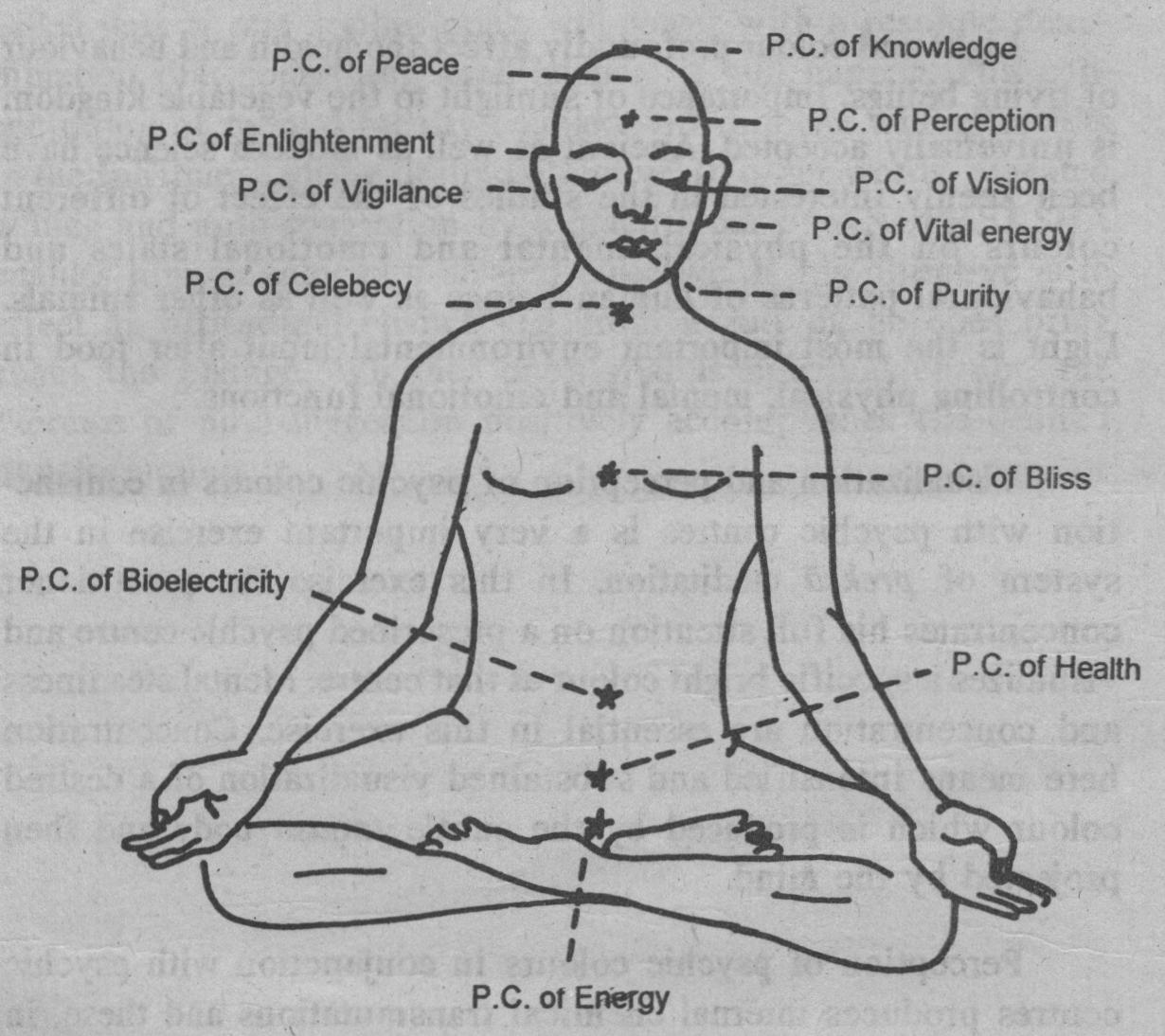 PSYCHIC CENTRES
 RAMNEEK’S SCIENCE OF LIVING AND PREKSHA MEDITATION CENTRE
 RAMNEEK’S SCIENCE OF LIVING AND PREKSHA MEDITATION CENTRE
 Veena a company general manager swerved her car swiftly from hitting the road divider on the highway on her way back home from the office, as the driver of another car overtook her without any warning or flashing the indicator. In a reflex action Veena lowered her side window glass and threw expletives on the driver of the other car. She could see a lady driver in the other car too appearing to be in a hurry to reach home after the office . “It could have been the end of my life today”, thought Veena,who was in a hurry to reach home much before her husband made it home.
 “Possibly the lady driving other car too has an enraged husband waiting at her home . That’s why the lady appeared to be in a hurry or it is likely that she has a sick child waiting at home”, justified Veena to herself . She found other car drivers behind honking at her , who had been equally disturbed by her abrupt change of direction to the right of the road . She breathed a few more swearing as she eased her car on the road again. Such a scene has become quite common in almost all towns where people appear to be in a mad rush with the surge of anger seething under their breaths. Veena could cool her anger by feeling empathy for lady driver of the other car. But how many of us can actually feel such an empathy for the one who has been the cause of our anger .
 Lets us analyse one more situation. Maharishi family has come out for a dinner with another family friend of theirs to a high class restaurant known for its elegant ambiance. As soon as the waiter had placed soup dishes on the table , Mrs Maharishi’s younger child insisted on serving the soup into her dish herself. The young baby could hardly handle the hot dish and found herself spilling the soup all over on the table.
 Many a times it would so happen that the anger comes to us in a sequence of various events and by the time we realize what has happened we end up losing control of the situation completely .This anger as we saw in the restaurant begins with one small event later on building up on the subsequent emotional reactions of angry outbursts.We just saw that anger had been building up on the earlier anger and the entire atmosphere had been converted into the inflamed oven of angry moods in the restaurant. The anger that had been just started with a small event got so intense after it found its subsequent hijacking devoid of any reason or logic .When we are engrossed into the angry atmosphere we just lose our sense of being and get carried away. This kind of anger had been built up not by the threat to the physical self but to the perceptive respectability, and disciplined family image of the Maharishi family . Mrs Maharishi felt insulted by the behavior of her child in the presence of her guests hence she had hit the child rather than at that time taking control of the situation and calming down her child.
 Manoj and his wife had been having argument for over a week now over some trivial matter. His wife noticed that every time the argument had begun Manoj would simply slip out of the house and return much later after her temper had died down. She followed him in their next bout of angry expletives .Manoj had gone to the temple nearby . He sat amongst the bed of flowers in the green lawns of the temple. She sat next to him as he moved aside to offer her more space. All that was causing trouble in them had been forgotten and they both decided to come to the same place next time an argument would start among them.Manoj told her that he would always allow himself a cooling down period every time he lost his temper , by coming to the calm and serene garden. Such distraction really works wonders on the mind and makes it one with the atmosphere .
 Lesson learnt : Move out to the place of your liking when you get angry. The place can be the garden nearby, a place of worship, a coffee shop, a favourite restaurant, a small drive around the corner and reflect calmly on the atmosphere rather than pursuing the train of anger from which you have just execused yourself .
 Family Always Comes First
 Alka Mansik Pramarsh Foundation Clinical Psychologists-Family therapists Indore 0731-4263087,9179383554