We reproduce below the interview of our Ramneek Kapoor Psychologist and Family Therapist once again for the benefit of our readers and clients.

1 .What is ‘stress’
“I would refer to stress as “the mental, psychological, intellectual, emotional and physical unease to the personal situation and the expectation rose either by the self or by others to face/handle the situation “.
- Are all kinds of stress bad? How do we identify between good and bad stress?
“All kinds of stress is not bad, only the distress caused is bad. Eustress is a good stress that gives a high and stimulates the adrenaline. When you feel good about certain situation and event and feel you are able to handle it, you look forward to such a situational stress which results into a moral boost and good emotional physical feeling”.
- Do you think people are aware what stress does to their mind, body and soul? Do you think that once they realise how negative stress has adverse effects on them, they will be in a better position to manage it?
“Only a limited few numbers of people could be aware of the negative effects of the stress on their physical, mental, social, spiritual and emotional well being. Mere realisation that the stress is bad will not be enough. We need to also educate and inculcate in them the stress relieving self empowering meditation exercise routine on day to day basis. Preksha Meditation (perceptive meditation on the psychic centres) under the guidance of trained teacher will go a long way in relieving stress.
- In the world we are living in today, how important is it to spread awareness about stress? Are there any statistics that reveal how serious the problem of stress is one’s life?
“The very fact that more than 50 percent people suffer from the depression, anxiety and stress sometimes or the other in their life with no trained professional help to cope with this reflects the pitiable position of the awareness amongst common people. In fact no official statistics from any governmental source are available on the subject nor has any NGO worked on the subject authentically”.
- How do you think our previous generations managed stress better than today? Even with the state of the art technology and advance in medical sciences, why have we as humans not been able to cope/ deal with stress?
“It is a fashion to always refer to the better life of the previous generation. The fact is that the technological advancement has also brought with it the person related emotional, psychological and physical maladies in addition to making life easier. The state of art tech development has brought about personal isolation, in the midst of many. The person today is cut off and alienated from the self. He or she is always lost into an uncalled for competition with the others on the social media and into the realms of the imaginary virtual world.
- Do you think people today are ignorant about stress? Ignorance is bliss, but is this kind of bliss worth it?
“No they are not ignorant. They prefer living in the comfort of uncomfortable stress. The rat race takes its toll and the victims enjoy the bites of killing stress and anxiety and many other mental ailments. Eventually the person ends up with either cardiac problems or the chronic depression and anxiety will take toll on such persons “.
- Are there some observable and prominent symptoms a stressed individual will experience? Such as physical, mental, emotional, physiological etc.?
“Yes ;the breathing discomfort , sleeplessness , insomnia, loss of memory, eating disorder either binge eating or not getting hungry, social anxiety, irritation , unmanaged anger, repeated headache, psychosomatic pains , and weight gain/ weight loss are some of the prominent observable symptoms”.
- Who are the most stressed people according to you? What could be the causes for them being the most stressed?
“Adolescents, working women, housewives, company executives and even professionals with deadlines of times to meet are always under stress. But the large share of the stress cake goes to adolescents in the modern times. With the race to always look outwards and keep pace with the demands of peer aping the adolescents find it difficult to cope with the stress. This generation is neither amongst the younger generation nor are they amongst the adults. The social media, the rigid demands on their performances in academics and career aspirations’ of the parents for them, are some of the major reasons for this generation being most stressed
- What according to you triggers ‘stress? Do you think by being aware of the triggers we can be in a better position to manage stress?
Triggers of stress can be any event or situation that threatens the mental and physical equilibrium (homeostasis) of the body . The events can be either external or internal
. External can be the political, social, economic, competitive, family, academic, or work atmosphere. While internal triggers will relates to irresponsible behaviour, uncalled for self expectations, negative attitude towards life in general, and looking for perfectionism in self or others.
- What can be some of the long-term effects of stress? How does stress affect a person physically, mentally and emotionally?
The long term effects of chronic stress can be
- Chronic sadness and depression. (2.) Chronic mental and physical fatigue. (3.) Chronic stress related illness (consistent headache, stomach ache, bowel problems, social anxiety) and other psycho somatic physical illness. (4) Isolating self, withdrawal, self destructive nihilistic thoughts .
Physical problems of the stress can be , sleep disorders, back, shoulder or neck pain, migraines , headaches, acidity, upset bowels, constipation, weight gain or loss, hair loss, loss of libido.
Emotionally the person can become nervous, edgy, depressed, moody, phobic, and not be able to focus and eventually suffering from Nervous breakdown.
- Please mention 5 useful tips for fighting/ managing stress? How can one follow these in his/her daily schedule and busy day?
- Accept life as it comes.
- Accept your self.
- Identify “ME” and try to become “ME” rather than becoming him, her ,they or she.
- Accept that perfectionism is a myth and utopia.
- Follow a healthy diet plan, an exercise and meditation routine to keep your heart health and positive.

- According to you, how can one prevent stress in everyday life? How do we know that the levels of stress have crossed the healthy limits? Until when can a person manage it on his/ her own?
“Stress is a natural occurrence but taking on too much can be avoided . Relax whenever you feel mentally, physically or emotionally exhausted before your stresses break you down”.

- Stress does not tend to only affect one person; its effects tend to spill over to the people around them. How do you think that we as a friend/ family member help a person dealing with stress?
“Stress is a personal problem but its manifestation can be felt and definitely seen in the family, friends and other areas of one’s life. The friends and family too should know that the life has to be lived in positive moments and as such the negativity should be eliminated from the life completely.

- What message would you like to give to our readers this Stress Awareness Month?
“Live life in positive emotions, the negatives are not meant for the living “.





 Ashu (name changed) could not do anything in life ever since he had been diagnosed of schizophrenia by the psychiatrist. He had been prescribed psychotic medicines by different psychiatrist doctors wherever his family had taken him to them .Yet nothing helped. His fears and phobias had worsened with time. The voices in his head continued disturbing him. His logical cognitive ability had been completely distorted and for him all the delusions had become the real images and characters.
 Similarly Sheena (name changed) continued with the fear and phobia of persecution at the hands of a person who had long moved out of her life five years ago. Sheena had been diagnosed of delusional disorder (a psychotic disorder).Her life had become completely miserable as she would often get lost into her phobia and would not be able to conduct her normal day to day routine life.
 Soon a very significant improvement could be noticed in certain negative symptoms, (e.g., negativity about self and family, sense of doom, lack of interest in surroundings and /lack of drive) started yielding to positive thoughts on all these issues .The clients did respond well as we noticed Ashu and Sheena both had begun looking at the positive aspects of their life. Their sense of appreciation for some aspects of their lives could be felt in their daily interaction with us. We could see their interest reviving in their day to day life too exhibiting positive symptoms.
 “Perceptive Meditation enables you live in and with your breath taking your mind away from your anxiety stress and worries of life .It empowers you to live in the moment with complete mindfulness of your soul ,body and mind “. Ramneek Kapoor.
 Mindful Perceptive Meditation on Psychic Centres is a very powerful, evidence-based meditation tool for enhancing emotional ,psychological and mental health.
 Perceptive meditation is a technique of meditation on the psychic centers of human body by which changes can be brought to the emotions,feelings,perception,attitudes, behaviors, and the total thinking process of the man. Perception on the psychic centres refer to the process of focussing and meditating on these centres of consciousness with complete absorption of mind and body and getting them connected to the endocrine glands situated on the psychic centres . The chemicals secretions this way are rectified by turning the secretion from negative to positives. Such Perceptive Meditation energises the conscious, the subconscious and the unconscious thereby benefiting the body and the mind on three different levels :
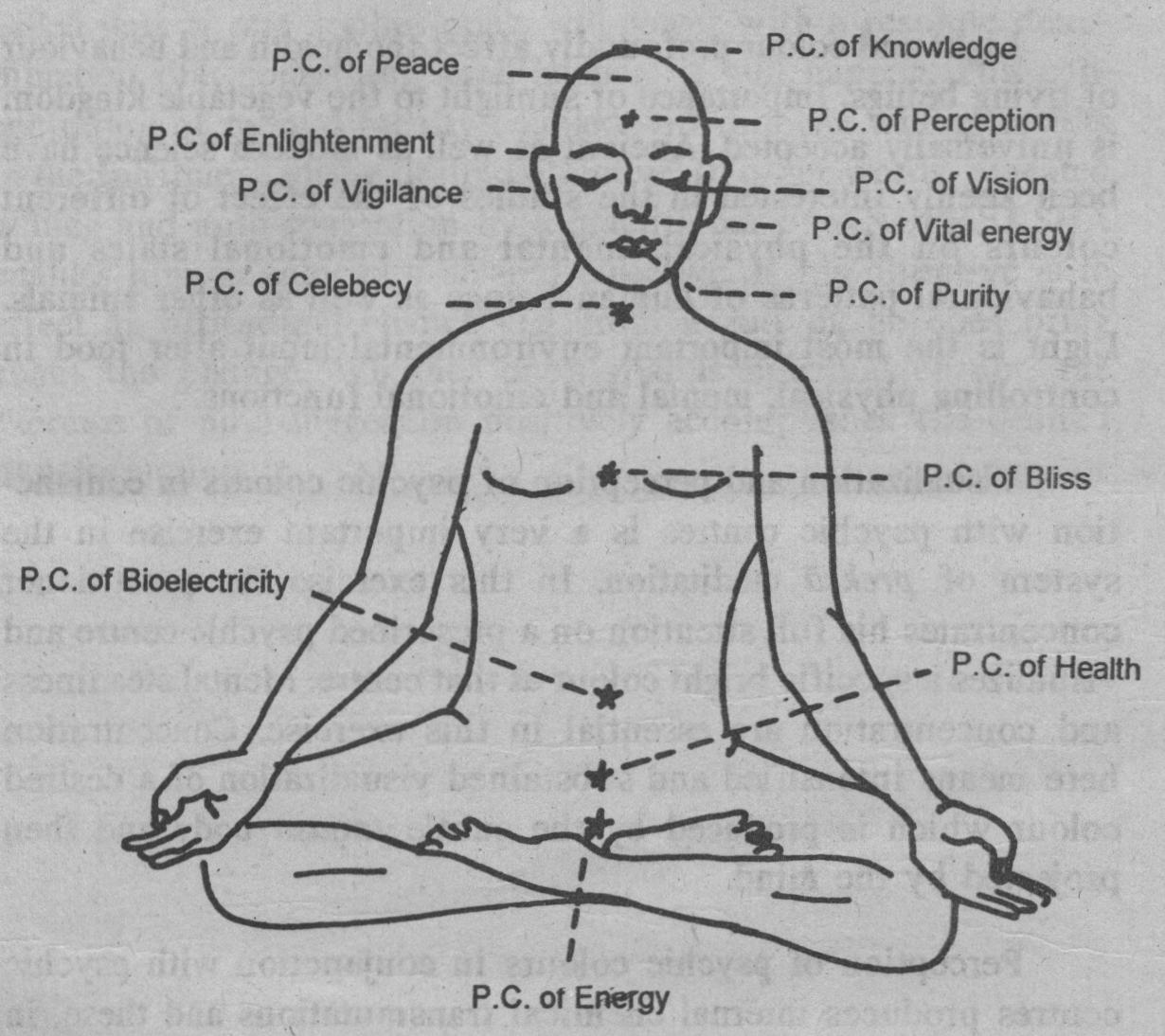 PSYCHIC CENTRES
 RAMNEEK’S SCIENCE OF LIVING AND PREKSHA MEDITATION CENTRE
 PSYCHIC CENTRES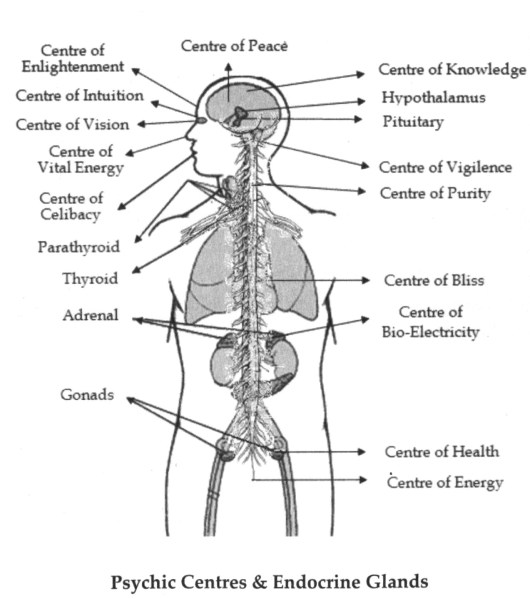


 RAMNEEK’S SCIENCE OF LIVING AND PREKSHA MEDITATION CENTRE
 Mrs Sharma sounded worried when she handed over the school bag of her daughter to bus attendant, “Please tell the driver not to drive too fast. He fetches small children, They can fall off their seats “. The bus attendant just nodded her head in affirmation. Not satisfied with just a nod, Mrs Sharma moved to the front of the bus .”Please drive slow and take care of our children” she had told the driver. The driver too nodded his head. Mrs Sharma waited for the bus to move. She kick started her scooter . She paused for a moment and then turned her scooter towards the direction in which the bus had been going. She followed the bus at a safe distance and eventually having seen the bus safely getting into the school gate, she turned back . Such melodrama has been going on with Mrs Sharma for over a month now.
 Julie is only six years old .She studies in the neighborhood kindergarten school. She had been fine all this while and used to be very eager to go to school every morning .Last week suddenly out of the blue she complained of stomach ache and refused to go to school. Her mother had taken her to the pediatrician who found nothing wrong with the child . The child had been referred to the school counselor. A few sessions with the parents, the child and the class teacher revealed, the child has been always worried about her mother being alone at home and this worry always prevailed upon her mind.
 Mrs Narwhal was so much worried of getting affected by the germs or carrying the germs back home that she would hang an extra set of clothes in her toilet in advance , which she wanted to wear the moment she would get back home from her trip outside. Every time she had come back to her house, she would first get into the bath to wash her clothes, bathe herself in order to cleanse herself of all the germs that she thought she might have brought with her from outside. She would feel completely relieved once having done this ritual .But it is obvious, such a ritual can be a great pain to other members of her family as the rule of changing into the fresh clothes after returning from outside and of washing the clothes that had been worn for going outside immediately on return from outside played havoc with the peace of the family . Any kind of advise to Mrs Narwhal to stop worrying created further problems as she would avoid such person who would advise her to not to worry .

 Tanisha (name changed) has been married for seven years into her second marriage. Her earlier marriage had not last long enough and before she could realize that she has been married, she was out of the
  It is obvious Tanisha has to bear the brunt of her husband being unemployed . She is mistreated by her mother in law too. Tanisha has been moving forth between her parents house and her in laws like a bouncing ball very frequently. The last time she had been away for over six months ( this being longest period of her leaving her husband ). Yet she comes back every time .Every month it happens either she is told to leave her in laws’ place by her mother in law or her husband or she would leave in a huff after the fight vowing never to come back . Her life goes on in spite of the mental, physical , emotional , economic and social abuse.Neither her parents want her to leave her husband nor is she confident enough to lead her life independently.
 Relationship abuse is the most common form of psychological, abuse people indulge into to hold a sway over others or allow others to hold a sway over them. It is a kind of psychological exploitation by the perpetrator . At the same time it is also an unnecessary comfort area the victim gets into refusing to come out of it.
 The low self-esteem in women can be the result of having undergone childhood abuse — which can instill fear of the unknown change .Doubts of self empowerment can raise their tolerance for abuse, and neglect . Such women have reported at least one incident of abuse in their early life , whether physical or psychological.Psychological abuse included things like, “touching inappropriately by a friend or a relative”, “ being bullied in their childhood”, ” being called fat or ugly”, ” having been ignored by parents, guardians, or“ being hurled insults by teachers , tutors, classmates or companions “.Most of the abuse the study indicates are psychological.
 “It is possible that women with childhood abuse histories are more satisfied in their relationships than women without childhood abuse histories because they have more tolerance for mistreatment based on early life experiences and resulting interpersonal experiences ”, the researcher points out ,“…the more psychological abuse women are exposed to, the more energy and effort they put forth to resolve the conflict, thus leading to increases in perceived investment.”
